Why can Fas ligand displayed by activated T cells lose cell-death function in a plasmin-rich tumor environment?
Fas ligand (FasL) on immune cells can activate the Fas death receptor on target cells. This study compared primate FasL sequences and tested whether a human P153S substitution makes the ligand susceptible to cleavage by plasmin. In the experimental systems reported, plasmin impaired FasL-dependent killing, while shielding FasL or inhibiting plasmin restored measured function.
FasL is a membrane-associated signal that can initiate apoptosis through Fas/CD95. Plasmin is a protease that can be elevated in some solid-tumor environments. The study asks how the physical integrity of immune-cell FasL affects a cell-death pathway relevant to immunotherapy.
Publication figures
Original figures, shown without alteration. Follow each source for the full legend, methods and panel-level data.
Further evidence: Figure 7 — Cell and tumor-model tests in plasmin-expressing settings (external link)
Evidence and methods
The authors compared FasL sequences among primates, tested recombinant and cell-associated ligand cleavage by plasmin, examined activated lymphocytes, and used ovarian tumor model systems to test functional consequences. The paper reports interventions that block plasmin access to FasL or inhibit plasmin activity.
A species-linked sequence difference
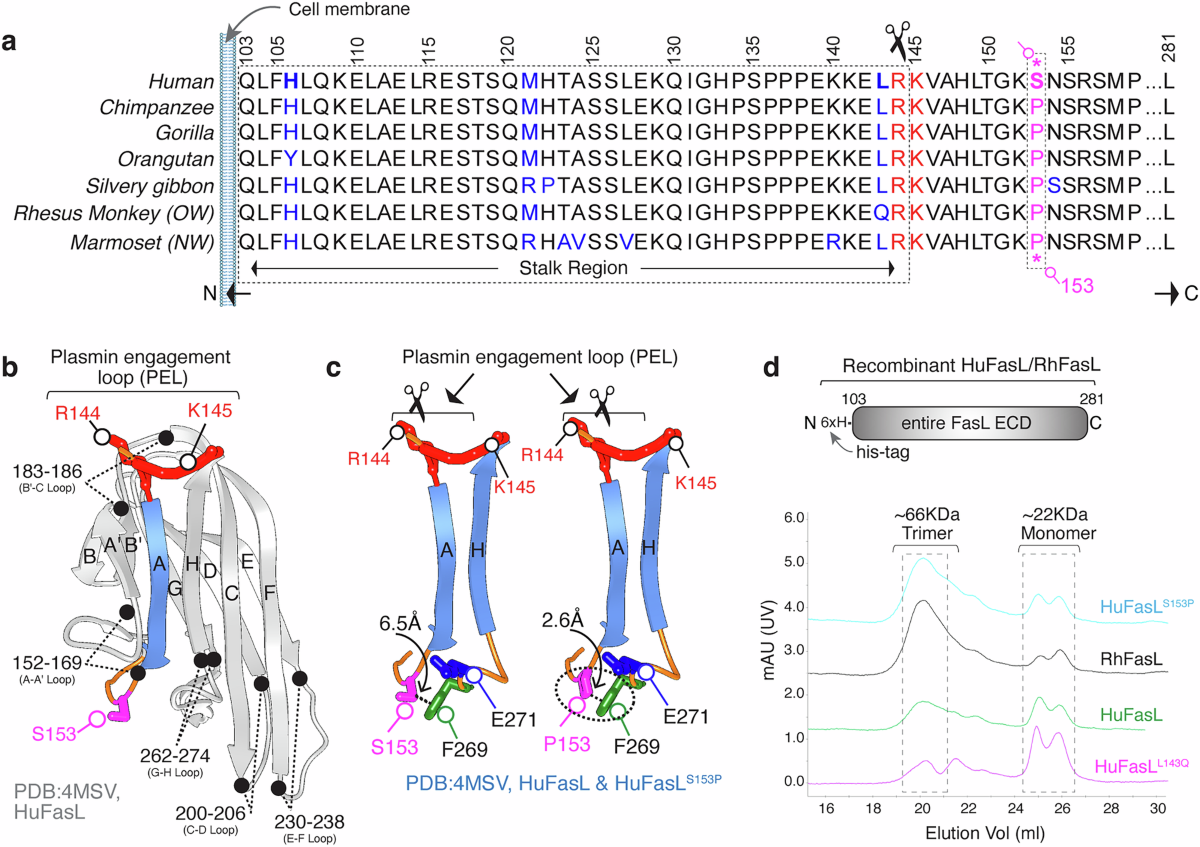
The authors identify human FasL P153S as a change associated with plasmin susceptibility compared with tested nonhuman-primate FasL sequences.
Cleavage changes a functional signal
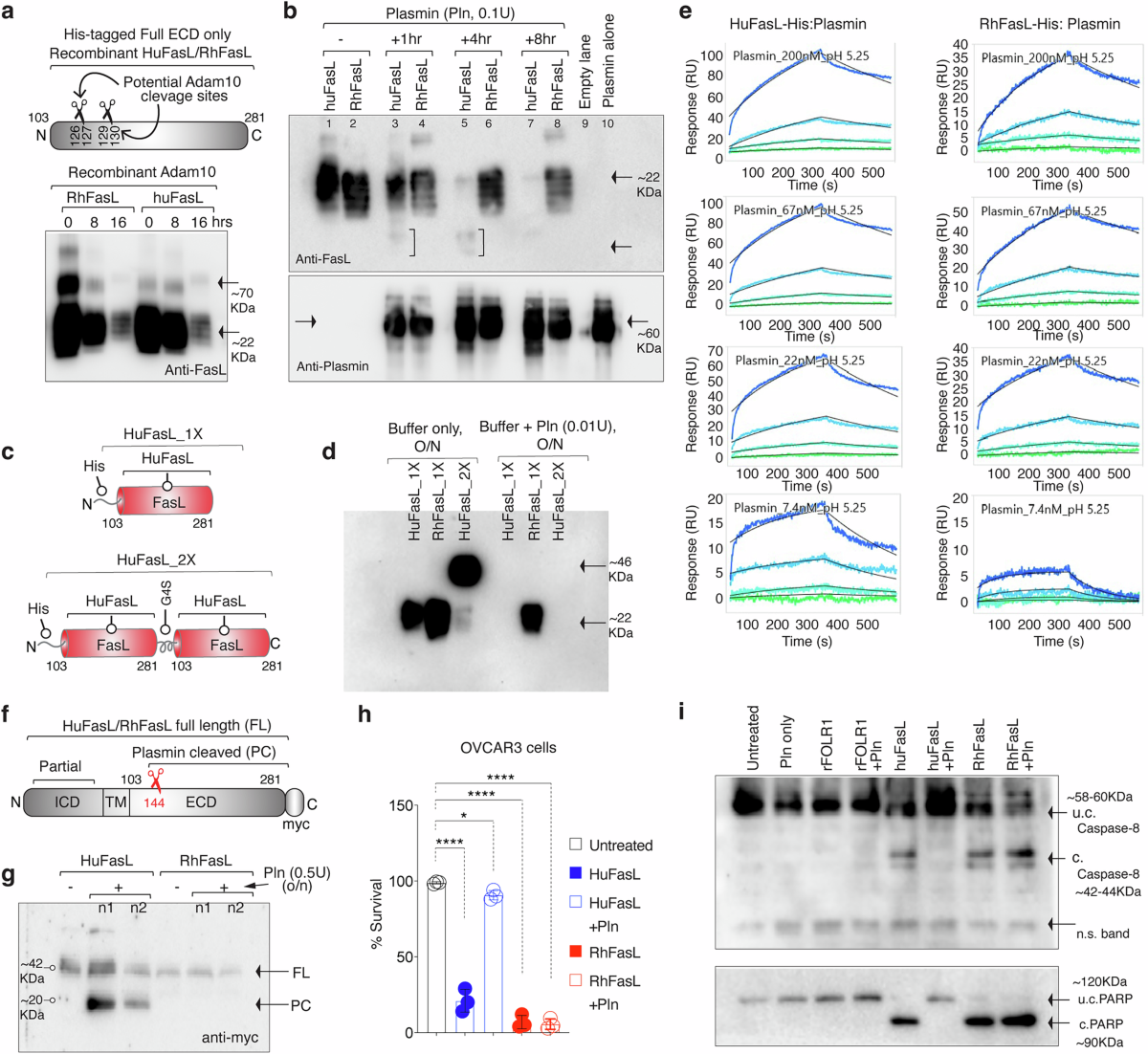
In studied cellular settings, plasmin exposure reduces membrane FasL availability and FasL-mediated tumor-cell killing.
Intervention restores measured activity
Plasmin inhibition or shielding of membrane FasL rescues FasL-dependent cell-death readouts in the reported experimental contexts.
Tumor context matters
The paper connects elevated plasmin in selected ovarian tumor material to the proposed immune-evasion mechanism; this does not establish a universal cause of human cancer risk.
Inside the study
Sequence to mechanism
The paper compares FasL across primates and focuses on the human serine at position 153. Substitution experiments test whether that residue changes plasmin sensitivity, moving the argument beyond a sequence correlation.
A membrane signal is vulnerable
Plasmin cleavage matters because membrane FasL on activated lymphocytes is positioned to engage Fas on neighboring tumor cells. The experiments distinguish intact ligand and soluble cleavage products, then test consequences for tumor-cell apoptosis.
Rescue is a mechanistic test
The investigators use nonhuman-primate FasL variants, a human S153P substitution, plasmin inhibition, and FasL-shielding single-chain antibodies. Concordant rescue across these approaches strengthens the proposed cleavage mechanism in the tested models.
Combination setting
The paper also reports an anti-PD-L1 combination in mouse tumor experiments. Those data ask whether preserving FasL changes a checkpoint-treatment response; they are not evidence of a proven patient regimen.
Interpretation
The supported model is a sequence-sensitive proteolytic step: plasmin cleaves susceptible human FasL, reducing the intact ligand available to trigger Fas on a target cell. The rescue experiments test that model under defined conditions.
Evidence stage
This is preclinical mechanistic research. It does not prove that P153S determines individual cancer risk or that plasmin inhibition improves patient outcomes. The tumor settings and intervention conditions were specific to the paper.