Which Fas receptor features determine whether an antibody triggers death signaling in the studied ovarian cancer setting?
The team characterized a regulatory Fas epitope and tested agonist antibodies in ovarian cancer models. The paper links receptor recognition and glycosylation context with cell-death activity, and examines Fas-dependent bystander effects associated with CAR-T targeting.
Fas/CD95 is a death receptor. Agonism requires more than simple receptor binding: where and how a reagent engages the receptor can change signaling. In antigen-heterogeneous tumors, bystander killing means effects on cells that lack the direct CAR target.
Publication figures
Original figures, shown without alteration. Follow each source for the full legend, methods and panel-level data.
Further evidence: Figure 7 — Fas agonist and FasL combination experiments (external link)
Evidence and methods
The paper combines antibody epitope characterization, Fas receptor perturbations, cell-death assays and ovarian cancer models, alongside CAR-T bystander experiments. Its mechanistic claims should be read with the exact receptor and cell conditions reported in the article.
Epitope location matters
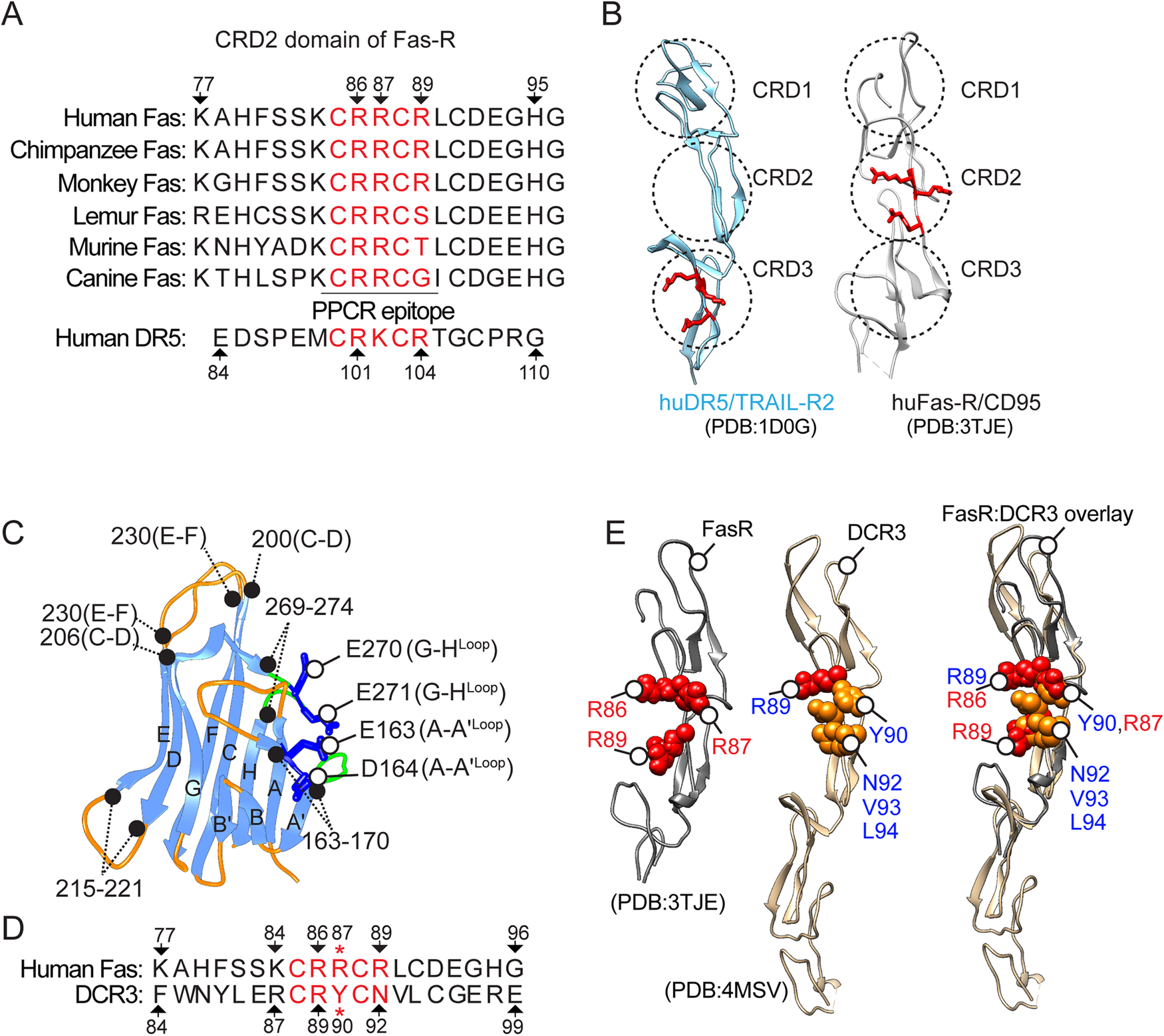
The study identifies a regulatory Fas epitope critical for the tested agonist antibodies.
Receptor state affects response
Experiments connect epitope access and receptor glycosylation context to differential antibody activity.
Bystander killing has a Fas component
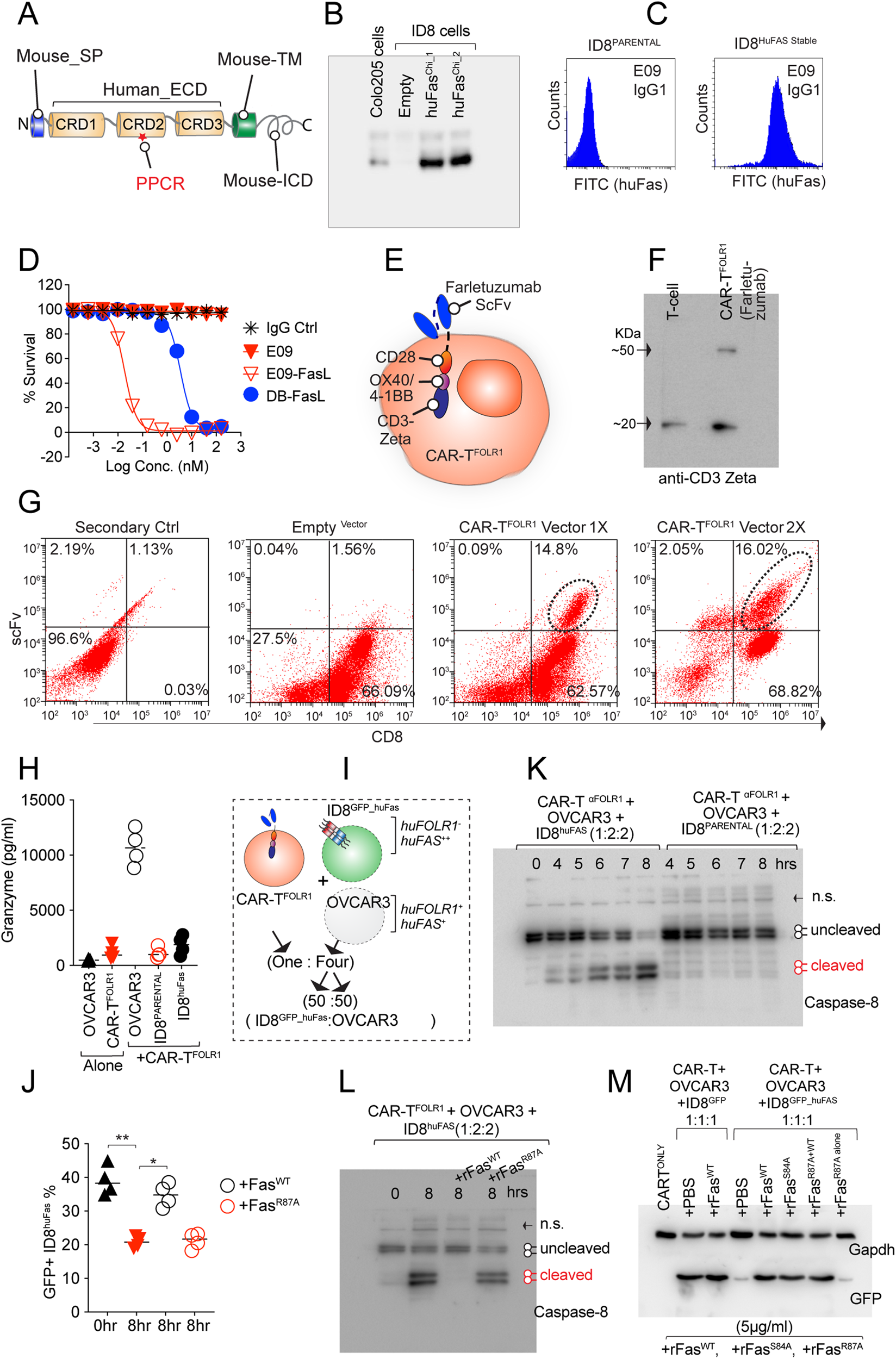
The study tests Fas-dependent effects in its ovarian cancer CAR-T bystander setting.
Inside the study
The PPCR motif
The work centers on a positively charged regulatory region in the Fas ectodomain. Its R87 residue is tested by mutation, connecting local receptor chemistry to agonist activity in the reported systems.
Direct agonism and bystander function
The team compares engineered Fas agonists with CAR-T co-cultures. Antigen-negative cells can undergo Fas-dependent bystander killing when antigen-positive neighbors activate the CAR-T cells.
Why neighboring cells matter
The experiments with FOLR1 and NaPi2b-directed CAR-T designs distinguish direct antigen recognition from Fas-mediated effects in heterogeneous cultures. The R87A perturbation helps test the Fas mechanism.
Interpretation
The experimental model centers on epitope-dependent receptor engagement followed by apoptosis signaling. The work also motivates selective Fas-targeting antibody formats described in a later UC technology disclosure.
Evidence stage
Preclinical receptor and tumor-model experiments. The results do not establish safety or efficacy of a Fas therapy in patients, nor do they imply that every CAR-T bystander effect is Fas-mediated.